Showing posts with label Secondary. Show all posts
Wednesday, 21 May 2014
Tuesday, 8 April 2014
OUGD505: Design Practice 2 - Product, Range, Distribution (Interactive Exhibitions)
I saw an exhibition for a museum in USA and I loved it! I would love to be able to propose something like this for my Oscar Moments exhibition.
Source
Source
This interactive table and wall experience with an accompanying online exhibition immerses visitors of all ages in the quest for justice and equality in the United States.
From the abolition of slavery to defining workplace rights, protecting privacy to censorship, the permanent Records of Rights exhibit at the David M. Rubenstein Gallery at the National Archives draws on the Archives’ extensive collection of historic documents, images, and videos to share the history of the American struggle for freedom. At the center of the exhibit, a 15’ multi-touch, multi-user table allows individuals and groups to explore a wealth of diverse content. Simple, color-coded themes help users navigate the table, and they can search across categories to investigate the areas that interest them most. Scrollable timelines create visual narratives that expand and contract, and influencing events give greater context to the stories. Users can pinch and zoom for a closer look at the remarkable documents and photographs.
Perhaps most importantly, the table urges visitors to talk to each other about what they’re discovering. They can tag records with their emotional reactions and post these responses to nearby wall monitors for fellow visitors to see. Active table stations receive a notification when a record is shared, encouraging users to start a dialogue about the table’s content and deepening their engagement with the exhibit.
An accompanying online exhibition takes the important stories of triumph and struggle in our country beyond the gallery’s walls, allowing users to explore the table’s content from anywhere in the world.
Monday, 7 April 2014
OUGD505: Design Practice 2 - Product, Range, Distribution (The Bafta's)
As the project is based on Product RANGE and distribution I wanted to look into other prestigious awards ceremonies like the Oscars. The British version of the Oscars is the BAFTA's.
The British Academy Film Awards are presented in an annual award show hosted by the British Academy of Film and Television Arts(BAFTA). It is often considered to be the British counterpart of the Academy Awards.[1][2][3] As of 2008, it has taken place in Central London at the Royal Opera House, the latter having taken over from the flagship Odeon cinema on Leicester Square. The 67th British Academy Film Awards took place on 16 February 2014.[4]
British Academy of Film and Television Arts (BAFTA) was founded in 1947 as The British Film Academy, by David Lean, Alexander Korda, Carol Reed, Charles Laughton, Roger Manvelland others. In 1958, the Academy merged with The Guild of Television Producers and Directors to form The Society of Film and Television, which eventually became The British Academy of Film and Television Arts in 1976.
BAFTA's stated charitable remit is to "support, develop and promote the art forms of the moving image, by identifying and rewarding excellence, inspiring practitioners and benefiting the public". In addition to high profile awards ceremonies BAFTA runs a year-round programme of educational events including film screenings and tribute evenings. BAFTA is supported by a membership of about 6,000 people from the film, television and video game industries.
The Academy's awards are in the form of a theatrical mask designed by American sculptor Mitzi Cunliffe, which was commissioned by the Guild of Television Producers in 1955.
The ceremony previously took place in April or May and since 2002 it takes place in February in order to precede the Oscars. The awards are mostly open to all nationalities, though there is an award for Outstanding British Film and Outstanding Debut by a British Writer, Producer or Director. Only for UK films are eligible for the categories of The British Short Film and British Short Animation awards.
The Awards ceremony is delayed broadcast on British television the same evening (usually BBC One), and across the world.
From 2000 to 2007 the ceremonies took place at the flagship Odeon cinema on Leicester Square. As of 2008, the ceremonies take place at theRoyal Opera House.
Until 2012, the mobile network Orange sponsored the awards and starting in 2013 Orange's parent company, EE, began sponsorship.
OUGD505: Design Practice 2 - Studio Brief 3 Research
____
Visual research for my film poster
I want my film poster to be vector based so I carried out search for some vector images posters.
I like the idea of creating the image in layers like this design.
Tuesday, 11 February 2014
OUGD505: Design Practice 2 - The Oscars Idina Menzel
She's a regular on the Broadway stage, but Idina Menzel will finally perform on the Oscar stage.
ABC confirms the Tony Award-winning actress will sing Let it Go, the Oscar-nominated song that you can't (and don't want to) get out of your head, during the Academy Awards on March 2.
In Disney's animated film Frozen, Elsa (voiced by Menzel) sings showstopper Let it Go when she triumphantly unleashes her icy powers that had been suppressed. AYouTube clip of the Let it Go animated sequence has garnered over 85 million views.
Menzel is best known for originating the role of Elphaba in Broadway's Wicked, and for playing Maureen in Broadway's Rent. She also played Shelby, the biological mother of Lea Michele's Rachel Berry on Glee.
OUGD505: Design Practice 2 - Study Task 1 Research Concepts
I am still exploring the different concepts and products I can produce for 505 studio brief 2. I know that I want to create something digital based as it is something I enjoy. Having said this, there are lots of other digital applications and websites based on the Oscars so I will have to create something unique.
I found this app on Behance and found it really interesting. I think the aesthetics are very professional and look more high end and developed than other apps which are around at the moment. I particularly like the iconography of the app and the colour scheme which has been chosen. I think that due to the nature of my topic and the background behind it it is necessary for my designs to reflect the standard of design which comes with the Oscars. This will be an interesting prospect for me to look into as I do not usually produce work which is more bespoke and special, I like to work with commercial design which is meant for large quantities of people.
Wednesday, 15 January 2014
OUGD504: Design Production - ISTD Existing Museum Websites
As I am creating a website for my ISTD brief I carried out a quick search of all the museums I could think of to see what information they had on the homepage and what other pages they had on the website. I have a rough idea of what I want to put on my website and I think that my search will confirm this.
National History Museum:
There is a clear grid on this page and the layout has cleverly been designed to show lots of information in subtle way. I think that it is very appealing as it draws in the eye, I also think that the proportions of image and type is very level which is good for the user.
National Science Museum:
The science museums website is much more minimal which is something which I want to achieve when I design my website. I think the use of a large image banner along the top of the page is very interesting and sets up the user for a visual experience rather than reels of text.
Royal Armouries:
The Royal Armouries website is a mix up of the science and history museum, the image to text ratio is consistent and the page reflects the aesthetic of the museum. I think this is important with this kind of establishment and I will take this into consideration when designing my website.
The Design Museum:
The design museum website surprised me, I was expecting something a little more interesting that this. I think this type of design is for a specific type of museum and I do not think that Type Factory fits this aesthetic.
The V&A:
The V&A museum is one of my favourites, I think the use of more image than text is very pleasing. I want to try and achieve this kind of aesthetic when I design my website.
Eureka:
The Eureka website is definatley designed for children, it is clear with the use of colour and images. I think that the colour of a website says a lot to the user as they make a snap judgement within a few seconds of being on the page.
Tuesday, 14 January 2014
OUGD504: Design Production - ISTD Print Research
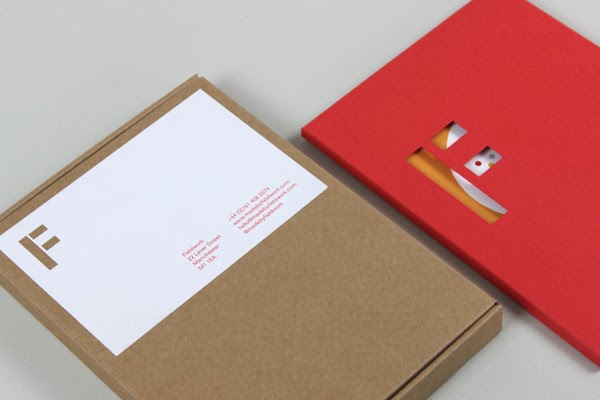
Now that I have put together a few ideas for my logo I can now look into different print options for my museum. I found this branding for a design company and really liked the laser cutout effect on the envelopes and business cards. I think I would like to try out this idea with my work as I think it could add a really nice effect to the museum. I also think it would be a great way to use stock as a colour instead of printing in multiple colours.
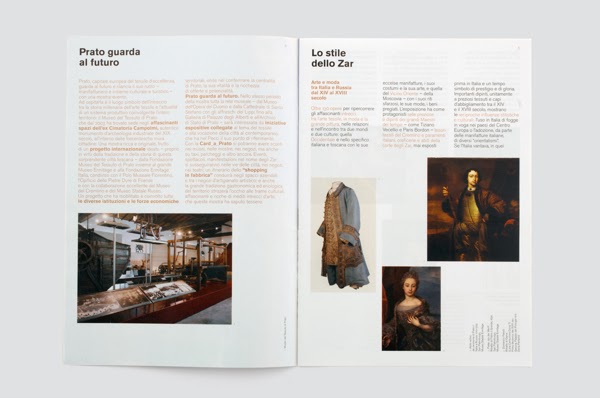
I also looked at other museum branding and print paraphernalia which I could produce. I know I want to create a web focused project but I need to produce some items for print as I think my project needs it. I looked on Behance for some examples of museum branding which is already being used in the industry. I think a small brochure is needed to give guests an idea of what are exhibitions are on at the time. I also want to propose the signage for the museum which will just be as simple as the other print products and consistent throughout the project.
I also need to think about creative ways to advertise the different exhibitions which are on at the time. This can be as simple as adding some text with a larger image behind it, I found this example on Behance and I think it is a great and simple way for me to add to my print section of my project and it also looks very professional.
Subscribe to:
Posts (Atom)